
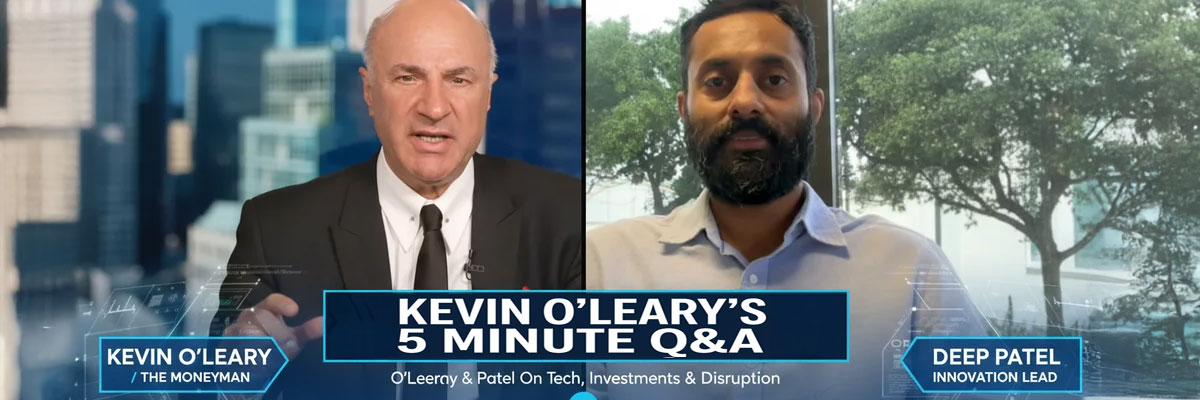
Kevin O’Leary Reacts to GigaWatt’s $50M Proof
If you only watch one part of this clip, jump to the moment Kevin O’Leary pauses the pitch and says the quiet part out loud:
“The $50 million says it all. That’s actually quite impressive.”
Because on StartEngine, most pitches start with an idea. This one starts with proof.

Key Takeaways
GigaWatt has generated $50M+ in gross revenue from 2019 through the end of 2024, disclosed in our Form C
The business was built to win in the post-subsidy solar market through vertical integration and cost discipline
70% of the customer base is residential, 30% commercial
Customers can go fully DIY, hire a licensed installer, or use a hybrid approach
Payback periods vary by state, with some markets seeing paybacks as low as five years even without the tax credit
GigaWatt delivers full solar and storage kits plus permitting and interconnection support to help customers get approved and turned on
A Few Lines Worth Quoting from the FULL Interview
“We’re a vertically integrated solar and energy storage company built for the post subsidy market.”
“There’s just too many middlemen and layers between the manufacturer and the end user that drives up costs.”
“From 2019 through the end of 2024, we’ve generated over $50 million in gross revenues nationwide.”
“The $50 million says it all. That’s actually quite impressive.”
The Big Idea Behind the Pitch
The solar market has a structural cost problem. Too many layers sit between manufacturers and homeowners, which inflates prices and slows adoption.
Deep’s pitch was simple. Cut out the layers. Integrate more of the stack (Gigawatt's "E-Stack"). Make distributed energy affordable without relying on subsidies.
That matters now because the residential federal tax credit expired at the end of 2025, and the industry is being forced to compete on real economics.
GigaWatt has been preparing for that moment for years.
Read the full details or watch our 2-minute pitch video on our StartEngine page.
Quick Q&A From the Interview
What does GigaWatt do?
GigaWatt provides complete solar and storage kits that include panels, racking, inverter, and battery, plus services that help customers through permitting and utility interconnection.
Why does vertical integration matter?
Because every handoff in the traditional supply chain adds cost, delay, and finger-pointing when support is needed. Integrating inventory, fulfillment, software, and hardware is how you reduce “junk costs” and protect unit economics.
How did Kevin react to the business proof?
He zeroed in on the $50M+ gross revenue figure and called it “quite impressive,” signaling that this is an operating business, not a concept.
How much of the business is residential vs commercial?
About 70% residential, 30% commercial.
Who installs the systems?
Customers have options:
DIY installation for those with trade skills
Hiring a licensed contractor
A hybrid approach where the customer handles some parts and hires out others

What does payback look like for residential customers?
It depends on the state, the utility rate, and how the project is executed. In higher rate markets like California, payback can be fast even without incentives. In lower rate markets, it can take longer.
What was interesting about this clip is how much the comments reinforced the point.
One DIYer shared they installed solar in California about 10 years ago and saw a 3 to 4 year payback. That matters because it was a decade ago when solar hardware was generally more expensive and electricity was cheaper than it is now. Even then, DIY customers were already seeing real ROI.
Now zoom out to what is happening across the country.
The same way people feel the squeeze on groceries and the general cost of living, more homeowners are starting to feel it in their electric bill. Utilities have to upgrade aging infrastructure, and those costs get passed through. At the same time, demand is rising, EV adoption continues, and data centers are scaling fast. Over the next 5 to 10 years, that pressure is not staying confined to a handful of expensive states.
That is why the payback math that used to feel “California-only” is starting to show up in more places. More markets are getting unlocked, and faster paybacks are becoming less of an outlier and more of a pattern.
What problem does GigaWatt solve beyond hardware?
Getting approved and turned on is a big one. Permitting and utility interconnection can slow projects down, and most homeowners do not want to learn the bureaucracy just to flip the switch. GigaWatt adds services that help customers move through those steps without getting stuck.
The bigger unlock is what happens after the hardware shows up.
Solar and storage is easy to sell when everything is working. The hard part is support, especially in the DIY niche where customers want real answers, fast, from people who actually know the system. That support layer is one of the main reasons this segment has stayed underserved even though demand is real.
That is why we are pairing proprietary Real Goods hardware with Real Goods software. Hardware lowers costs and improves consistency. Software helps customers manage efficiency and performance over time, and it creates a scalable support layer that can guide troubleshooting, answer questions, and reduce friction as the market grows.
It is the combination that matters. Better hardware, clearer guidance, and a support experience that can scale without breaking as more homeowners adopt DIY solar and storage.

Why This Matters for Investors
This was a five minute pitch, but it highlighted what most Reg CF campaigns struggle to show.
Operating history. Real customers. Real transactions. A model built to survive policy shifts.
A lot of energy startups look great in a sizzle reel. The harder question is who is behind it. Have they lived through supply chain swings, policy changes, utility friction, and real world installs? That is where most newcomers get exposed.
Deep has been in this market since 2006. Our team has spent years in the field learning what works, what breaks, and what customers actually need. That experience is one of the biggest moats in a category where support and execution decide who wins.
If you want to see the full campaign details, visit our StartEngine page. At minimum, create your StartEngine account and hit the heart icon to add us to your watchlist. That is where we will post the most important campaign updates.
Add GigaWatt to your StartEngine watchlist or invest here →


