
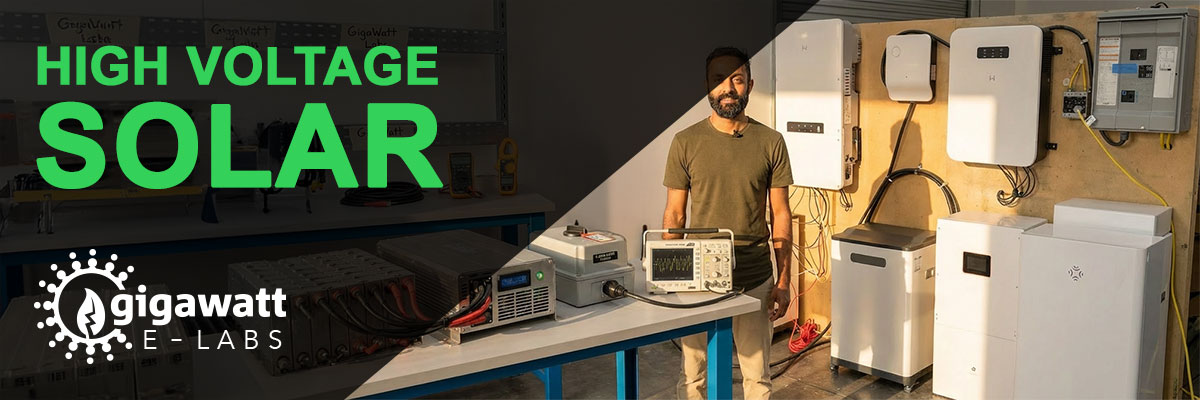
Testing High Voltage Solar and Storage at GigaWatt Labs
Why real world validation matters for DIY and off grid systems
Solar and storage is not a spec sheet. It is a system people live with.
At GigaWatt Labs, we test complete setups the way customers actually use them, with real loads, real surges, and real failure points. This is part of what we have learned after 19 years in DIY solar: the difference between a system that looks good on paper and a system that holds up in real life is usually found in the edge cases.
One of the biggest edge cases is inrush current.
What is inrush current and why it breaks systems
Inrush current is a short burst of very high power draw when certain devices turn on.
Common examples include:
Blowers
Well pumps
Compressors
Power tools
HVAC motors
Any inductive load with a motor that “kicks” on

This surge is exactly where many lower voltage systems struggle. The system can sag, reset, or crash under the sudden demand, even if the total running wattage looks fine.
The test we ran in the lab
We built a simple but revealing stress test that mirrors how people actually use their equipment.
Step 1: Start a real load
We plugged in an EV charger drawing about 6 kW and began charging a Tesla from a high voltage system.
Step 2: Add a high surge load
Then we turned on a blower, which creates a sharp inrush spike right at startup.
What happened
The EV charger briefly dropped offline
The blower stayed online
The system kept running
The inverter did not crash
That is the key point. The overall system stayed stable.
Why high voltage systems can perform better here
High voltage systems can handle demanding start up surges more gracefully in many real world scenarios. That matters because in a home energy system, stability is the whole product.
When systems crash under inrush, the homeowner experiences:
Unexpected shutdowns
Load dropouts
Confusing behavior that is hard to diagnose
Reduced confidence in the system
If you have motor driven loads, high voltage architecture can be a meaningful advantage.

The bigger problem we see in the market
A lot of companies sell boxes. Inverter. Battery. Done.
But homeowners do not live with a box. They live with a system.
We constantly hear the same frustrations:
Systems undersized at the inverter level
Designs that ignore inrush behavior
“Spec sheet sizing” that does not match real use
Customers stuck troubleshooting issues after the fact
This is one reason we are building proprietary hardware under the Real Goods brand. Better products start with more transparency and tighter alignment with how customers actually use power at home.

Why our approach is different after 19 years in DIY solar
DIY solar does not mean a homeowner wants to be left alone. It means they want ownership and control, with real support behind it.
After 19 years supporting DIY customers, we focus on:
Right sizing the system from the start
Designing around real loads, not just ideal conditions
Supporting customers through permitting and interconnection when grid tied
Helping homeowners succeed whether they install themselves or hire their own installer
Where software and AI support fits into this
Hardware is the foundation. Software is how the experience scales.
Alongside proprietary hardware development, we are building a proprietary software layer designed to extend the DIY experience. The goal is to translate what our technical team has learned over decades into a support experience that is faster, clearer, and easier to access.
What that enables for DIY customers:
Better guidance during planning and setup
Faster answers to common technical questions
More support at scale as the DIY segment grows
A smoother ownership experience after install
This is a major focus of our roadmap this year, and it ties directly into the same mission that has driven the company since 2006: help homeowners own their power with transparency and confidence.

Want help sizing a high voltage system
If you want to talk with a vetted solar advisor and learn more about high voltage packages, you can visit Unbound Solar. The team can help with:
Shipping
Permitting and interconnection for grid tied projects
Package options that support high voltage systems
Want to follow or invest in the bigger build
If you want to follow the company and get updates as we scale the Real Goods hardware and the software layer, you can visit our StartEngine campaign page.
You can follow the campaign, or invest and buy shares to support the mission.
FAQ: High Voltage Solar and Inrush Current
What is inrush current
It is a short surge of power some devices draw when they first start, especially motor driven loads.
Why do some systems crash when a motor turns on
If the inverter or battery system cannot handle the surge, voltage can drop enough to force a reset or shutdown.
Is high voltage always better than low voltage
It depends on the use case, loads, and design. High voltage can offer meaningful benefits for surge heavy environments.
Can DIY homeowners use high voltage systems
Yes, with the right design, packaging, and support. Many customers install themselves or hire their own installer and still want a properly engineered plan.


