
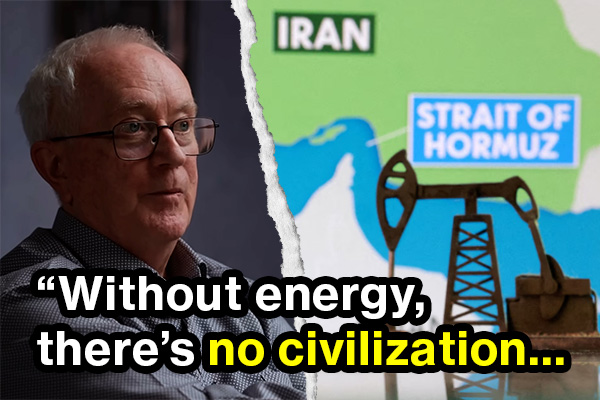
Financial crash expert: “If you’re reliant on oil, you’ve got a fragile existence”
He predicted the 2008 financial crisis before it happened. Now, he’s sounding the alarm as the Iran War strains the global energy market.
Source: The Diary of a CEO, via YouTube
In a recent episode of The Diary of a CEO, economist and author Professor Steve Keen pointed to rising geopolitical tensions including the Iran War and the blockade of the Strait of Hormuz as signals of deeper risk for the lifestyles of everyday people.
His warning is simple:
Modern life depends on energy. And right now, that system is more fragile than most people realize.
How Global Conflict Is Disrupting Energy Supply
Source: Federal Reserve Bank of Dallas
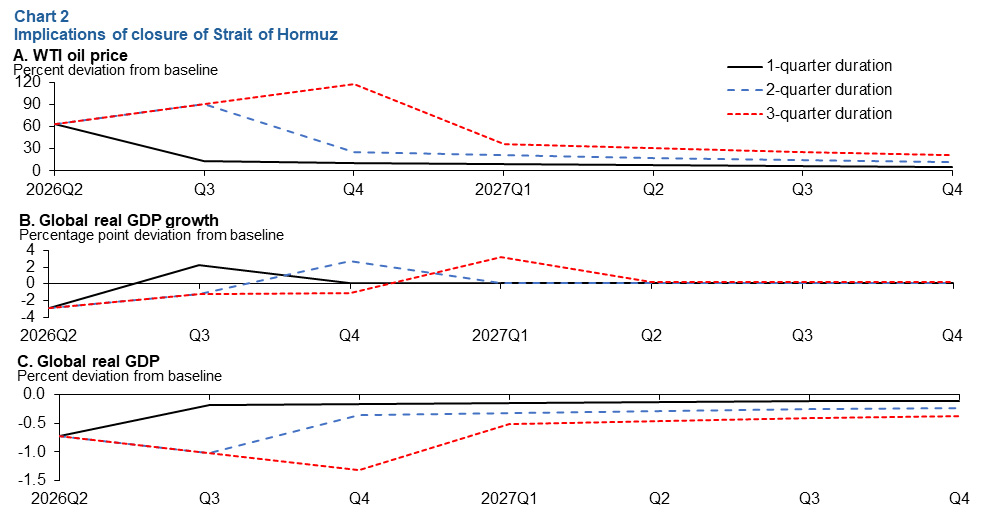
The ongoing conflict involving Iran has already disrupted one of the most critical energy chokepoints in the world: the Strait of Hormuz. At its peak, disruptions in this region can remove close to 20% of global oil supply from the market, sending shockwaves through prices and the broader economy.
According to the International Energy Agency, this may be the largest energy supply disruption in modern history, more severe than the oil shocks of 1973, 1979, and 2022 combined.
And we’re already seeing the real-world effects.
Across the globe:
Countries are rationing fuel
Airlines are canceling flights
Energy prices are rising sharply
In some scenarios, oil prices could climb as high as $200 per barrel, while supply shortages may take years—not months—to fully recover.
Even the mere threat of disruptions like this can:
Drive up energy prices
Slow economic growth
Increase volatility across markets
In other words, the global energy system isn’t just complex. It’s highly sensitive to conflict and disruption.
Why This Is Accelerating the Shift to Solar
"For your house, you need something which means you are not dependent upon oil anymore… and for most people that means having solar"
— Professor Steve Keen, Economist and Author
What’s different about this energy crisis isn’t just its scale. It’s the alternatives available.
For the first time, technologies like solar, battery storage, and EVs are both widely available and increasingly affordable.
And when traditional energy systems become unstable, people don’t just wait. They adapt.
Across the U.S., adoption of solar and other alternatives is already accelerating as households and businesses look for ways to reduce their dependence on volatile fuel markets.
What About the Cost of Solar?
One of the biggest reasons homeowners hesitate to go solar is the upfront cost.
And for a long time, that concern has been valid.
Traditional solar often comes with a high price tag because of how the industry is structured.
Studies from the National Renewable Energy Laboratory have shown that a significant portion of residential solar costs come not from equipment, but from ‘soft costs’ like sales, marketing, and overhead.
In many cases, homeowners are paying for multiple layers:
Sales organizations
Designers
Engineers
Installers
Financing companies
With markups added at each step.
By the time a system is installed, those layers can significantly increase the upfront cost for the homeowner.
A Different Approach: More Control for the Homeowner
As more homeowners begin to understand how solar is priced, a shift is starting to happen.
Instead of accepting a bundled, high-cost system, many are looking for a more efficient way to go solar: one that gives them greater visibility into what they’re paying for and more control over how their system is built.
At its core, the difference is the model.
Traditional solar often relies on multiple intermediaries, each adding cost along the way.
At GigaWatt, our approach is focused on simplifying that process, removing unnecessary middlemen while still providing the expertise needed to get a system done right:
Direct access to equipment. Homeowners can purchase complete solar and storage systems without going through multiple markups or sales layers.
Custom system design and engineering support. Each system is designed based on the homeowner’s specific needs, with guidance from experienced designers and certified engineers.
Flexible installation options. Customers can choose the path that works best for them—whether that’s project management with a local installer, taking a DIY approach, or using a hybrid model.
Lifetime support. Support doesn’t end after the sale. Ongoing technical guidance helps ensure systems continue to perform over time and adapts to meet your changing needs.
By reducing unnecessary complexity and focusing on transparency, our model is designed to make solar more accessible while giving homeowners more control over their system, without relying on the high-cost structures that have historically defined the industry.
For homeowners, this ultimately comes down to a simple tradeoff.
Do you want a fully hands-off approach where everything is handled for you at a premium?
Or do you want more control over how your energy system is designed, built, installed and maintained?
As energy costs rise and uncertainty increases, more homeowners are choosing the latter.
Not just to save money, but to gain a greater sense of sovereignty and resilience in how they power their homes and lifestyles.